Insurance Lead Generation
How Much Should Insurance Agents Spend on Facebook Ads?
A budget framework for insurance agents running Facebook ads: what to spend while testing, when to scale, and the arithmetic that ties spend to a lead target.
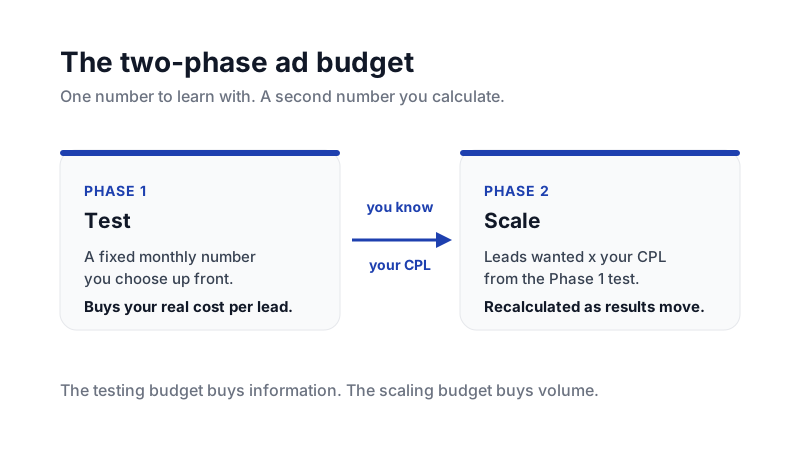
The first question agents ask in Prospect demos is some version of how much do I need to spend. Here is the honest answer: there are two budgets, and only one of them is a number anyone can hand you. The first is a testing budget, a fixed amount you choose up front and spend to learn what a lead costs in your market. The second is a scaling budget, which you calculate from what the test measured. Agents get into trouble when they expect the first month to behave like the second.
Guides for insurance agents commonly suggest starting around $20 to $30 a day, or $500 to $1,000 for a first month, as of July 2026. Those are reasonable defaults. The two phases below explain what the money is buying at each stage, which is the part the defaults leave out.
Phase 1: the testing budget buys information
The purpose of your first month of ad spend is to measure your real cost per lead. Cost per lead moves with your product line, your state, your creative, and your offer. Nobody can tell you the number in advance, and anyone who quotes your cost per lead before you have run anything is guessing.
That changes how you should pick the testing number. It is a decision about risk tolerance, so treat it like one:
- Pick an amount you can spend for one full month without flinching. If losing it would hurt the business, it is too big. If it is too small to run daily for a month, it is too small.
- Keep the daily budget consistent. Meta’s delivery system needs a stable run of conversions to settle; a budget that changes every few days keeps resetting that process.
- Change as little as possible while the test runs. Every big edit restarts learning, which means the money you already spent taught you less.
- Track every lead against the spend. The output of the month is one number: what a lead cost you.
Agents who come to us saying Facebook ads did not work usually cannot say what their cost per lead was. The campaign may have failed, or it may have been fine and untracked. Without the number there is no way to know, and the next attempt starts from zero.
Phase 2: the scaling budget is arithmetic
Once the test has produced a cost per lead you trust, the monthly budget stops being a guess. Decide how many leads you want, multiply by your measured cost per lead, and that is the spend.
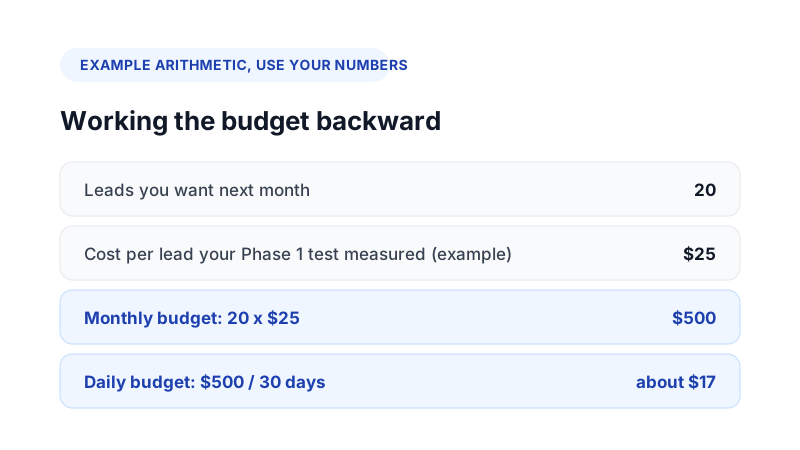
The numbers in the diagram are example arithmetic, not a prediction. Your test may measure a lower cost per lead or a higher one. What matters is the direction of the calculation: the budget comes from your target and your measured cost, never from a number in an article, this one included.
If the cost per lead your test measured makes the math unworkable, the fix lives in the campaign: the offer, the creative, or the landing page. Scaling a campaign you have not measured, or one whose numbers you do not like, is how budgets disappear.
Where ad budgets actually die
The failure stories agents tell us rarely involve the wrong budget size. They involve one of these:
- Judging in week one. The first days of a campaign are the noisiest and most expensive. A test judged early almost always looks like a failure.
- Restarting over and over. Pausing, editing, and relaunching feels like managing the campaign. Each restart throws away what the spend already taught the delivery system.
- Paying for leads and reaching them late. A lead that sat overnight is a different lead. If follow-up is slow, the ads can be working while the results say otherwise. The Dead Lead Cost Calculator puts a dollar figure on exactly this, using your own numbers.
- New creative every few days. Boredom is not a performance metric. Let the test finish before replacing what runs.
The same dollars, three ways
Budget questions are really comparison questions, so compare the three places the same monthly money can go.
Buying shared leads. The money buys names that are commonly resold to several agents at once, at the market prices covered in how much insurance leads really cost. Next month you buy again from zero. Our position on this model has not changed: it is a treadmill, and shared leads underperform for structural reasons that have nothing to do with your script.
Hiring a done-for-you agency. As of July 2026, marketing agency pricing guides commonly list monthly retainers between $1,800 and $6,000, before any ad spend. Our position: for a single agent, a retainer at that level mostly pays for account management, and the underlying work is something an agent can own with the right templates.
Running your own campaign. The spend goes to Meta, in your own ad account, at whatever number the two-phase framework produces. The leads it generates are exclusive to you and arrive the moment the form is submitted. The cost-per-lead number the spend produces is yours too, and it compounds: every month of data makes the next month’s budget decision easier. The full comparison lives in buying leads vs generating your own.
Is $5 a day enough to test with?
It can produce data, slowly. A $5 daily budget stretches the timeline: fewer impressions per day means more weeks before the results mean anything. The risk is judging a slow test as a failed one. If $5 a day is the ceiling right now, plan a longer test, hold the settings steady, and judge at the end, never in the middle.
How long should I run ads before judging them?
Give the test a full month of consistent settings. Two weeks of daily edits produces two weeks of noise, and no amount of analysis recovers a conclusion from it. The Facebook ads guide for life insurance agents covers what to hold constant and what a healthy first month looks like.
Should I pause my ads when the leads seem bad?
Diagnose before pausing, because pausing resets delivery learning. Check contact speed first: leads reached within minutes behave differently from leads reached the next day. Then look at the form itself, since forms that ask too little attract clicks without intent. Then look at targeting. Pausing is the right call only when you know which of those you are fixing.
What if I cannot afford a testing month at all?
Then do not run ads yet. A test you cannot afford to finish will get judged early, and an early judgment wastes the whole budget. Until a one-month test fits comfortably, the paths in alternatives to buying insurance leads cost time instead of money, and the ad budget question will still be here when the math fits.
When you are ready to run the two-phase framework, the Facebook ads for insurance agents page shows how Prospect, currently in private beta, structures the campaign side for agents who keep their own ad account: the ads, the landing page, and the instant lead delivery, with the budget in your hands the whole way.